
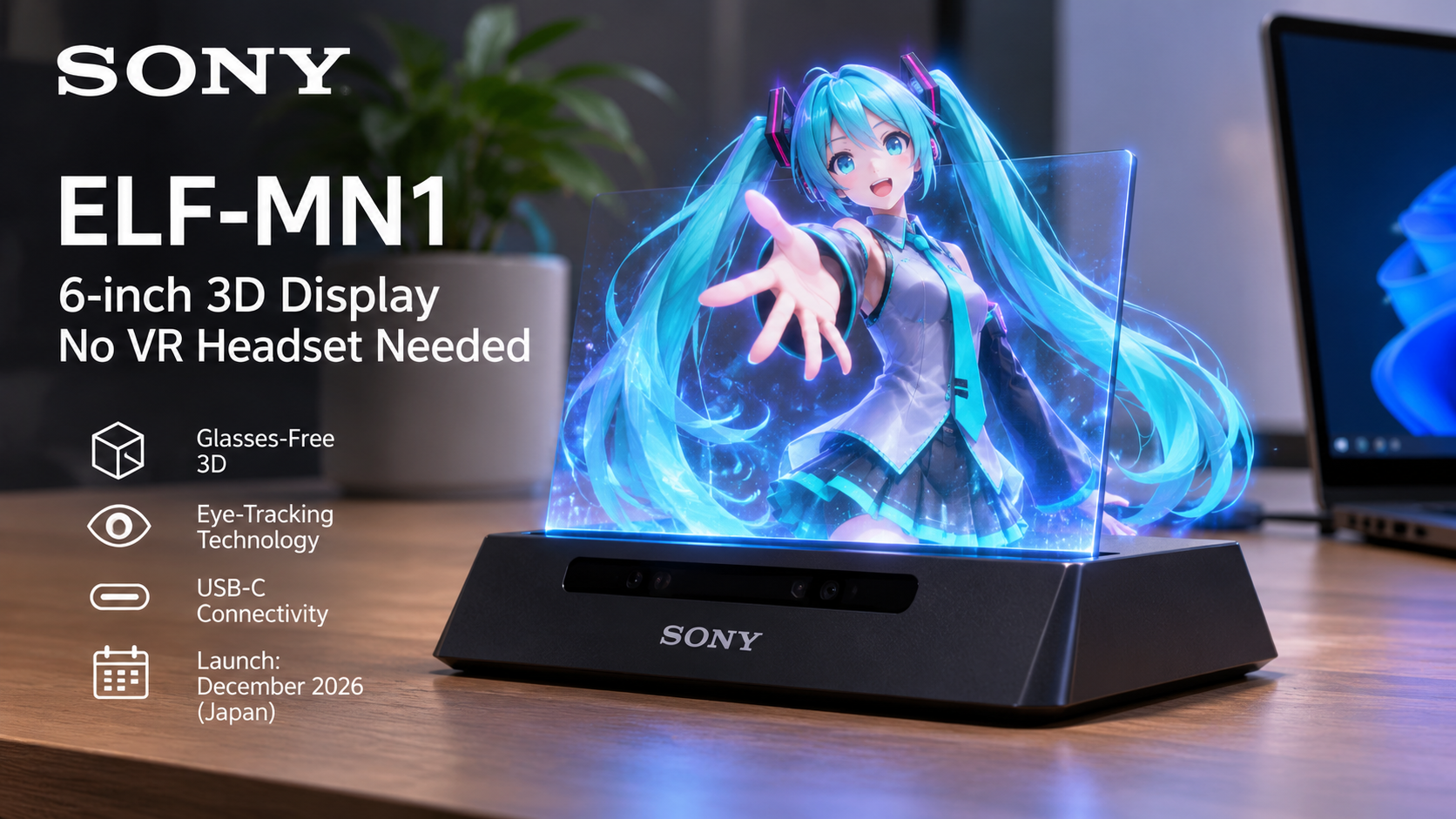
Credit: AI
Sony has introduced the ELF-MN1, a compact 6-inch spatial reality display designed to bring three-dimensional characters, avatars, and digital objects to life without requiring special glasses or a VR headset.
Announced as part of the company’s XYN spatial content ecosystem, the new device aims to make glasses-free 3D technology more accessible to everyday users, rather than limiting it to professional design studios and creative workspaces.
Eye-tracking technology creates a realistic 3D effect
The key feature of the Sony ELF-MN1 is its advanced eye-tracking system. Built-in sensors monitor the viewer’s eye position and adjust the displayed image in real time, creating separate perspectives for each eye. This produces a natural sense of depth, making digital objects appear as if they exist in physical space.
Sony has also integrated an infrared sensor to improve eye detection in low-light environments. The display offers a pixel density of 403 PPI, which the company describes as the highest among its spatial reality displays to date.
Connects directly to smartphones and PCs
The ELF-MN1 is designed for simple desktop use. Users can connect it to compatible Windows computers, iOS devices, and Android smartphones through a single USB-C cable supporting DisplayPort Alternate Mode.
The display supports 3D characters, virtual avatars, and spatial objects created using compatible applications. Sony is also providing a software development kit (SDK), allowing creators to develop and display their own spatial content.
One of the intended use cases is displaying digital figures through services such as Gugenka’s HoloModel, bringing virtual characters closer to the experience of having a physical collectible on a desk.
Release date and expected price
Sony plans to launch the ELF-MN1 in Japan on December 11, 2026. The estimated retail price is approximately 54,000 yen, although the final price will depend on individual retailers.
The company has not yet announced international availability.
With its compact design and glasses-free 3D technology, the ELF-MN1 represents another step toward bringing spatial computing experiences into everyday environments. Whether it becomes a mainstream desktop accessory will largely depend on the availability of compatible content and developer support.


