
Credit: AI
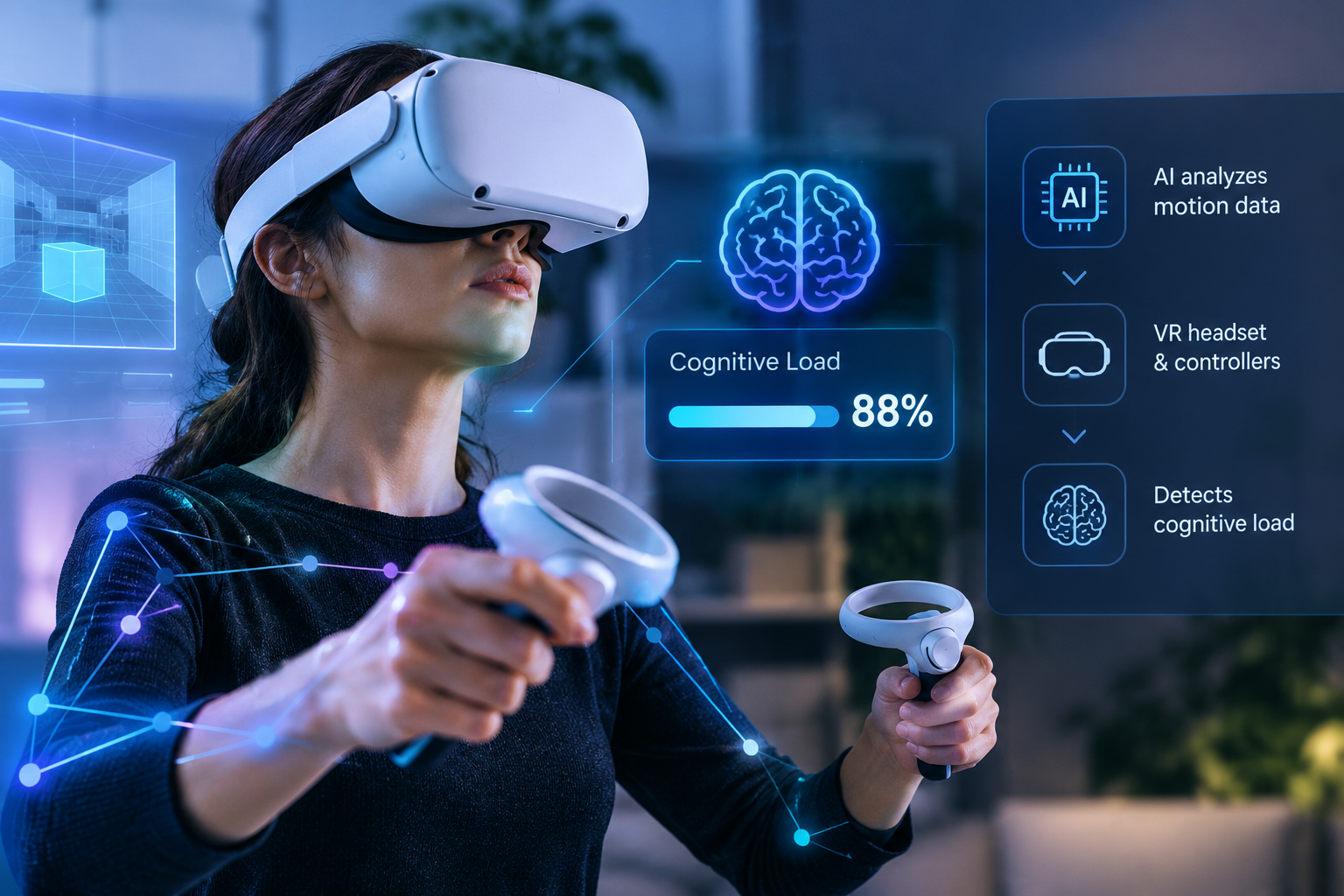
Artificial intelligence is making virtual reality more responsive to the people using it. Research suggests that machine learning models can estimate cognitive load — the mental effort required to complete a task — by analyzing movement patterns captured by VR headsets and hand controllers.
A study presented at the 2022 International Conference of the Immersive Learning Research Network explored whether motion-tracking data could reveal how mentally demanding a virtual learning experience was. Using a recurrent neural network, researchers reported more than 88% accuracy in distinguishing between different levels of cognitive load.
Turning VR Movement into Cognitive Insights
Traditional methods of measuring mental workload often rely on questionnaires completed during or after a task. While useful, these assessments can interrupt learning and may not capture changes in cognitive effort as they happen.
AI offers another approach. By analyzing motion data collected through VR headsets and controllers, machine learning systems can identify patterns associated with different levels of mental demand without requiring users to stop and report how they feel.
The approach could help developers understand when a virtual task is too easy, appropriately challenging, or potentially overwhelming.
What This Means for VR Learning
The technology has promising applications in education, professional training, and simulation-based environments. For example, a VR training platform could eventually adjust task complexity, provide additional guidance, or introduce breaks when a learner appears to be struggling.
However, the reported 88% accuracy should not be interpreted as a universal measure of how well AI can read human cognition. The result comes from preliminary research, and performance may vary depending on the task, participants, training data, and evaluation methods.
Further studies are needed to establish how reliably motion-based estimates generalize across different users and real-world VR applications.
The Future of Adaptive Virtual Reality
As VR systems become more sophisticated, combining motion tracking with other signals — such as eye movements and physiological measurements — could provide a more comprehensive picture of user workload.
The long-term opportunity is to move beyond virtual environments that simply deliver content toward systems that respond intelligently to individual needs. If researchers can validate these methods across broader settings, AI-powered cognitive-load estimation could become an important tool for making immersive learning more effective and accessible.