
Credit: AI
Meta is expanding its vision for the future of web development with the release of Immersive Web SDK (IWSDK) 1.0. Announced on October 14, 2026, the latest version gives developers a more accessible way to create interactive 3D experiences that run in web browsers and on compatible virtual reality devices.
The framework aims to reduce the technical complexity of building immersive applications, allowing developers to focus on content, interactions, and user experience rather than creating core systems from scratch.
A New Approach to Web-Based VR Development
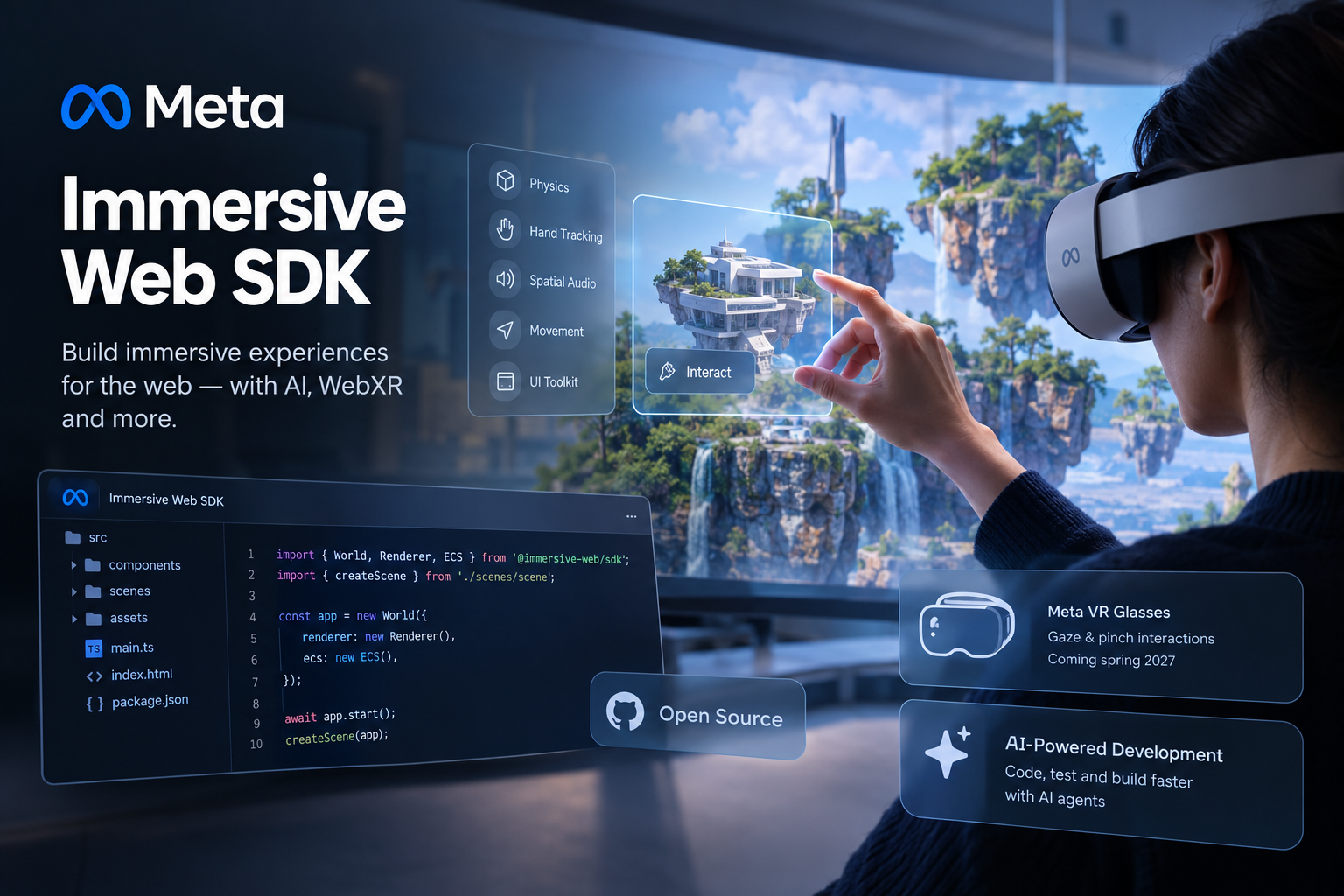
Built on Three.js and a high-performance Entity Component System (ECS), the Immersive Web SDK includes ready-made tools for physics, hand tracking, object manipulation, spatial audio, and movement in virtual environments.
Developers can also build spatial user interfaces using UIKitML, an HTML-like language designed for creating interactive 3D elements. These features can help power browser-based games, virtual showrooms, educational applications, and mixed reality experiences.
One of the framework’s main advantages is web accessibility. Instead of requiring users to download a dedicated application, developers can distribute experiences through a web link, with immersive functionality available on supported devices.
AI Tools Aim to Speed Up Development
IWSDK 1.0 introduces a more integrated workflow for AI-assisted development. Compatible coding agents can inspect 3D scenes, simulate user input, interact with virtual objects, and help identify and fix problems during testing.
Meta has also introduced an Agentic Scene Composer, enabling developers and AI agents to work on the same editable 3D scene. The approach combines visual editing with automated coding and testing, potentially reducing the time needed to build and refine immersive applications.
These capabilities could make WebXR development more approachable for smaller teams and independent creators who lack the resources to build complex VR systems from the ground up.
Preparing for Meta VR Glasses
Another important addition is support for Meta VR Glasses, with gaze-and-pinch interactions designed around looking at an object and selecting it with a hand gesture.
Because these interactions integrate with existing input systems, developers can reuse familiar interface elements instead of building separate interaction logic for every device. Meta says developers can begin testing these experiences before the glasses’ planned launch in spring 2027.
What This Means for the Future of the Web
The release of Immersive Web SDK 1.0 reflects a broader shift toward web experiences that go beyond traditional screens. By combining open-source development tools, WebXR capabilities, and AI-assisted workflows, Meta is working to make immersive content easier to build and distribute.
The framework’s long-term success will depend on developer adoption, device compatibility, and the quality of experiences it enables. However, its latest release offers a more complete foundation for creators exploring browser-based VR and mixed reality.


