Credit: AI
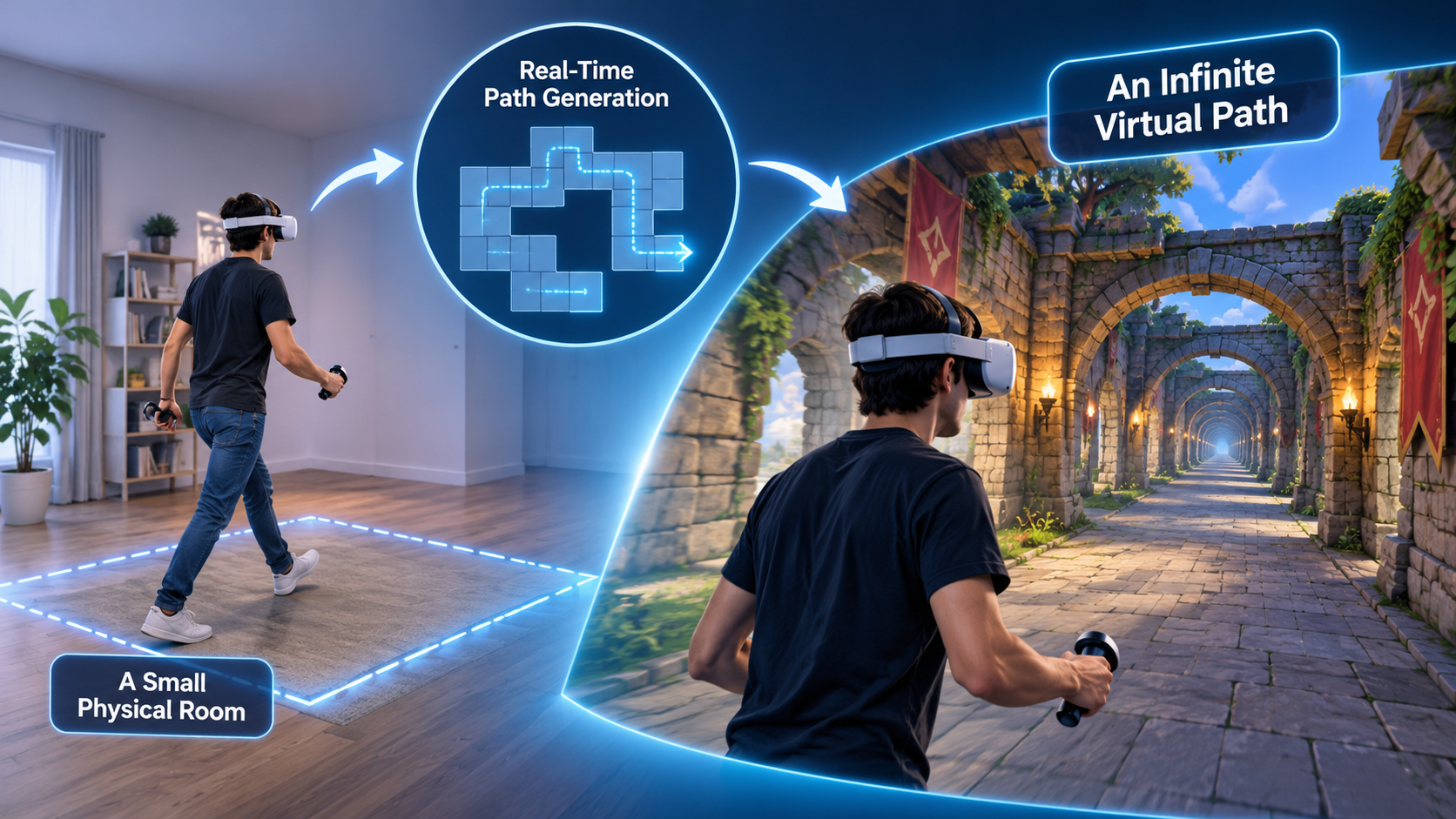
Virtual reality could soon make it possible to walk seemingly endless distances without leaving a single room. A new research project called Endless VR Walk introduces an approach that transforms a limited physical space into an effectively infinite virtual walking path.
Developed by researchers Sofia Martinez, Reagan Haddix, Miles Haase, and Angelos Barmpoutis at the University of Florida’s Digital Worlds Institute, the system aims to solve one of the biggest challenges in room-scale VR: the lack of physical space for natural movement.
How does Endless VR Walk work?
Instead of relying on joystick controls, teleportation, or expensive omnidirectional treadmills, Endless VR Walk allows users to move naturally by walking around a physical room.
The system uses a recursive path-generation algorithm that creates new virtual sections in real time as the user moves. These sections can extend forward or turn 90 degrees to the left or right, while the software ensures that the virtual route stays within the boundaries of the available physical area.
This approach allows users to revisit the same physical floor space while experiencing what appears to be a completely different section of a virtual environment.
Testing the limits of virtual walking
The researchers implemented the prototype using Unity and tested it with Meta Quest 3 headsets.
Their experiments examined how different room sizes affect the variety of generated paths. The results showed that a 3-by-3 grid produced a relatively repetitive circular route, while a 5-by-5 grid allowed significantly more variation, including zigzag patterns and changes in direction.
The virtual environment is built from modular sections measuring approximately 1.2 by 1.2 meters. To maintain performance, the system also reuses previously created 3D objects rather than generating every section from scratch.
Potential applications beyond gaming
Endless VR Walk could have applications well beyond traditional virtual reality games. Natural walking may make VR fitness experiences more engaging, while the technology could also be explored for physical therapy and rehabilitation.
For developers, the system opens up new possibilities for endless-runner games, platformers, and immersive environments where players can explore without being restricted by the dimensions of their rooms.
However, the technology is still at an early research stage. Further testing is needed to determine how convincing the illusion of endless movement feels to users and whether it can reduce discomfort associated with extended VR sessions.
If developed further, Endless VR Walk could represent an interesting step toward making large-scale virtual environments accessible from ordinary indoor spaces.